A failing dock leveler doesn’t just slow down your operation — it puts your workers and equipment at serious risk. If your loading dock leveler is making strange noises, moving unevenly, or not holding its position, those are warning signs you can’t afford to ignore.
The direct answer? If your leveler shows visible damage, hydraulic leaks, electrical faults, or fails to hold a load safely — you need professional dock leveler repair or inspection right away. Waiting too long can turn a minor service call into a full loading dock leveler installation.
In this guide, you’ll learn the most common warning signs, when to repair vs. replace, how the repair process works, and how to keep your dock leveler running safely for years.
What Is a Loading Dock Leveler and Why Does It Matter?
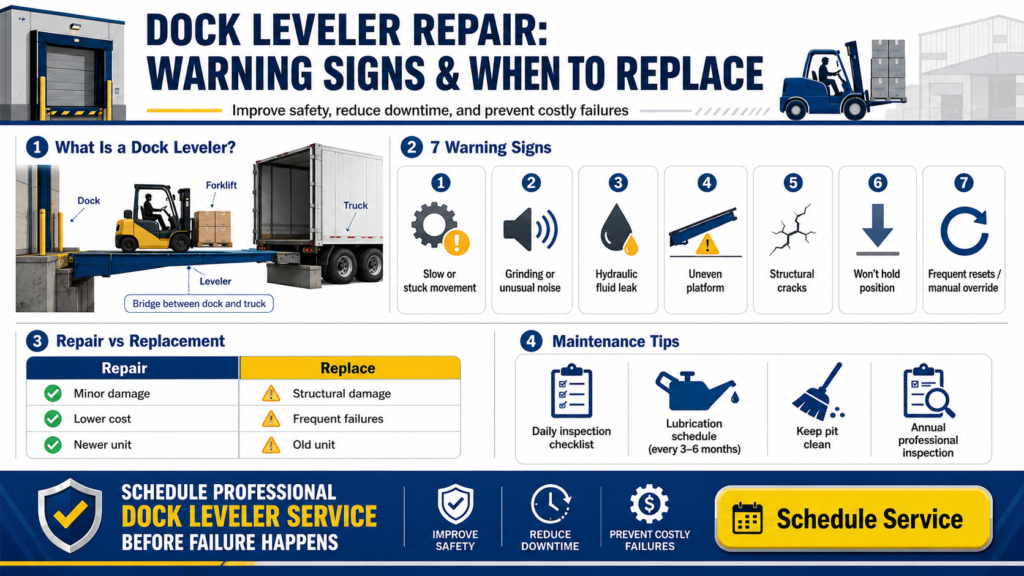
A dock leveler is the hinged steel platform that bridges the gap between your building’s loading dock and a delivery truck. It adjusts for height differences so forklifts, pallet jacks, and workers can move safely between the two surfaces.
Without a properly working leveler, loading and unloading becomes dangerous, slow, and physically demanding. A damaged unit can cause forklift accidents, product damage, and serious worker injuries.
For warehouses, distribution centers, retail facilities, and manufacturing plants, a functional dock leveler is not optional — it’s a core part of safe, efficient operations. That’s why routine loading dock service and fast repairs matter so much.
7 Warning Signs Your Dock Leveler Needs Repair
Dock levelers give clear signals when something is wrong. Here are the most important ones to watch for.
1. The Leveler Won’t Rise or Lower Properly
This is the most obvious sign. If the platform struggles to lift, gets stuck mid-way, or won’t lower to the truck bed, the unit needs immediate attention.
For hydraulic dock levelers, this usually points to low fluid, a failing pump, or a faulty cylinder. For mechanical units, it may be a broken spring or worn lip hinge.
2. Unusual Noises During Operation
A healthy dock leveler runs with minimal noise. If you’re hearing grinding, banging, popping, or squealing, something is wrong mechanically.
Common causes include:
- Dry or worn hinges
- Loose or broken hardware
- Damaged lip linkage
- Worn deck or frame components
Don’t ignore the noise and hope it goes away. In most cases, catching it early means a simpler, less expensive dock leveler repair.
3. The Leveler Won’t Hold Its Position
A dock leveler that drifts down on its own — or won’t stay level under load — is a serious safety hazard. Forklifts and workers depend on a stable surface. If the unit sinks while in use, someone can get hurt.
This is often caused by a worn hold-down mechanism, faulty hydraulic valve, or a broken safety leg.
4. Visible Physical Damage
Cracks, bent steel, torn dock bumpers, or a warped deck surface are all signs of structural damage. Some cosmetic issues can be repaired. But if the frame itself is bent or the deck has significant cracks, replacement may be the safer and more cost-effective path.
5. Hydraulic Fluid Leaks
If you notice dark fluid pooling under or around the dock leveler, you have a hydraulic leak. This will cause the unit to lose pressure and eventually stop working altogether.
Hydraulic leaks also create a slip hazard on the dock floor — a serious safety issue that needs same-day attention.
6. Slow or Sluggish Response
A dock leveler that used to move quickly but now responds slowly is losing efficiency. For hydraulic units, this typically means low fluid or a pump that’s beginning to fail. For air-powered units, it may be a pressure loss or valve issue.
Slow response times add up over hundreds of loading cycles and can significantly impact throughput.
7. Frequent Need for Resets or Manual Overrides
If workers are constantly having to reset the leveler, use the manual override, or jiggle controls to get it working, the unit is not operating as designed. Frequent workarounds are a strong sign that a professional loading dock leveler service visit is overdue.
Repair vs. Replacement: How to Decide
One of the most common questions facility managers face is whether to repair a damaged dock leveler or replace it entirely. Here’s a simple breakdown.
When Repair Makes Sense
- The leveler is under 10–12 years old
- Damage is limited to one component (cylinder, spring, lip linkage)
- The deck and frame are structurally sound
- Repairs cost less than 50% of a new unit
- Parts are still available for the model
When Replacement Makes More Sense
- The leveler is over 15 years old
- Multiple components are failing at the same time
- The frame or deck is cracked or severely corroded
- Repair costs approach or exceed the cost of a new unit
- The leveler type no longer meets your operational needs (e.g., you need a higher cycle rating)
Repair vs. Replacement Comparison
| Factor | Repair | Replace |
|---|---|---|
| Unit age | Under 12 years | Over 15 years |
| Damage scope | Single component | Multiple components |
| Frame condition | Structurally sound | Cracked or corroded |
| Parts availability | Available | Discontinued |
| Cost comparison | Under 50% of new unit | Close to or exceeds new unit |
| Downtime impact | Short-term fix | Long-term reliability |
| Safety compliance | Meets current standards | May need upgrade |
Types of Dock Levelers and Common Repair Needs
Different dock leveler types have different failure points. Knowing your type helps you understand what repairs to expect.
Hydraulic Dock Levelers
The most common type in commercial facilities. Powered by a hydraulic pump and cylinder. Very reliable but requires fluid maintenance and seal inspections.
Common repairs: Cylinder replacement, hydraulic pump repair, seal and hose replacement, valve adjustment.
Mechanical Dock Levelers
Operated by pulling a release chain and using body weight to lower. Simple design with fewer moving parts.
Common repairs: Spring replacement, lip hinge repair, hold-down mechanism adjustment.
Air-Powered Dock Levelers
Use an air bag system to raise and lower the platform. Fast and smooth operation.
Common repairs: Air bag replacement, valve repair, control box issues.
Vertical Storing Dock Levelers
Store in a vertical position when not in use, protecting the unit from weather and debris. Common in cold storage facilities.
Common repairs: Hinge maintenance, hydraulic system checks, seal replacement.
How the Dock Leveler Repair Process Works
If you’ve never scheduled a dock leveler repair before, here’s what to expect from start to finish.
Step 1: Report the Problem
Assign a team member to log any dock leveler issues as soon as they appear. Include the leveler number, the problem observed, and when it started. This information helps the technician prepare the right tools and parts.
Step 2: Schedule a Loading Dock Service Visit
Contact a qualified dock and door service provider. Reputable companies offer scheduled maintenance and emergency service calls. For safety-critical issues — like a leveler that won’t hold position — request same-day or next-day service.
Step 3: Technician Inspection
The technician will perform a full inspection of the unit — not just the reported issue. This includes checking the deck, lip, hinges, springs or hydraulics, electrical connections, and safety components. A thorough inspection prevents missed problems.
Step 4: Diagnosis and Quote
After the inspection, you’ll receive a clear diagnosis and a written quote. A trustworthy loading dock leveler service company will explain what needs to be fixed and why before any work begins.
Step 5: Repair or Replacement Decision
Based on the quote and the technician’s recommendation, decide whether to proceed with repair or move forward with loading dock leveler installation of a new unit. Take the age of the equipment, frequency of breakdowns, and long-term operational needs into account.
Step 6: Repair Is Completed and Tested
The technician completes the repair and runs the leveler through multiple full cycles to confirm it’s operating correctly. All safety features — including the hold-down, safety legs, and lip extension — should be verified before the dock goes back into service.
Step 7: Schedule Preventive Maintenance
Ask about a preventive maintenance plan before the technician leaves. Regular loading dock service visits catch small problems before they become expensive repairs or safety incidents.
Practical Tips to Extend the Life of Your Dock Leveler
Good maintenance habits can add years to the life of your equipment and reduce unexpected repair calls significantly.
- Inspect levelers daily before use. Train dock workers to do a quick visual check — look for fluid leaks, unusual sounds, and any movement that feels off.
- Lubricate hinges and moving parts regularly. Most manufacturers recommend lubrication every 3–6 months depending on usage volume.
- Keep the pit clean. Debris, water, and ice in the dock pit accelerate wear on the leveler frame and components. Clean the pit monthly.
- Never overload the leveler. Every dock leveler has a rated capacity. Exceeding it — even occasionally — stresses the frame and hydraulic components.
- Replace dock bumpers on schedule. Worn bumpers allow trucks to impact the dock structure directly, which transfers stress to the leveler.
- Schedule annual professional inspections. Even levelers that seem to be working fine benefit from a professional loading dock leveler service check once a year. Technicians can spot wear patterns that aren’t obvious to the untrained eye.
- Document all issues and repairs. Keeping a log makes it easier to identify patterns and plan for replacement before a failure catches you off guard.
Ready to Schedule a Dock Leveler Repair? Here’s What to Do Next
If your dock leveler is showing any of the warning signs covered in this guide, now is the time to act — not after an accident or a full breakdown during a busy shipping day.
Here’s your action plan:
- Walk your dock and check all levelers for the warning signs listed above
- Log any issues you find with the date and a brief description
- Contact a licensed dock and door service provider and describe what you’re seeing
- Request a same-day or scheduled inspection depending on the severity
- Get a written quote before any work begins
- Ask about a preventive maintenance plan to protect your investment going forward
The best loading dock leveler service companies will be honest, experienced, and able to handle both repairs and full loading dock leveler installation if a replacement is needed. Don’t work with a provider who can only do one or the other.
Conclusion
A loading dock leveler is one of the hardest-working pieces of equipment in your facility — and one of the easiest to overlook until something goes wrong. The warning signs are usually there well before a full failure. Catching them early means faster repairs, lower costs, and a safer dock for your team.
Whether you need a quick dock leveler repair, a full loading dock leveler installation, or a long-term loading dock service plan, working with an experienced dock and door service provider makes all the difference.
Frequently Asked Questions
A. The most common signs include the leveler failing to rise or lower, unusual grinding or banging noises, the platform drifting down under load, hydraulic fluid leaks, visible cracks or bent steel, and slow or sluggish operation. Any of these signs warrant a professional dock leveler repair inspection.
A. Most dock levelers last 15–20 years with regular maintenance. High-volume facilities that cycle the leveler dozens of times per day may see shorter lifespans. Annual loading dock leveler service inspections help extend the life of the unit and identify wear before it becomes a failure.
A. Minor tasks like cleaning the pit or lubricating hinges can be done by trained dock staff. However, hydraulic repairs, spring replacements, and structural fixes require a qualified technician. Attempting these repairs without proper training and tools creates serious safety risks.
A. Costs vary based on the type of leveler, the nature of the repair, and parts availability. Minor repairs like seal replacement or lubrication service cost less than component replacements like hydraulic cylinders or springs. Always get a written quote from your loading dock service provider before approving work.
A. If the leveler is over 15 years old, has multiple failing components, shows structural frame damage, or repair costs approach the price of a new unit, replacement is usually the smarter investment. A qualified technician can help you weigh the options after a full inspection.
A. A professional service visit typically includes a full inspection of all mechanical and hydraulic components, lubrication of moving parts, adjustment of the lip and hold-down mechanism, safety system checks, and a written report of any issues found. Some providers also offer scheduled maintenance plans that cover regular visits throughout the year.
A. Look for providers that specialize in dock and door service, have experience with multiple leveler types and brands, carry proper licensing and insurance, and offer written estimates. Ask about their response time for emergency calls and whether they stock common parts for faster repairs.