In the fast-paced world of logistics, your loading dock is the gateway to your revenue. When a dock leveler begins to malfunction—perhaps it’s sticking, making a grinding noise, or failing to support the weight of a forklift—the entire operation slows down. At this crossroads, every facility manager asks the same question: Is it better to call for dock leveler repair, or is it time for a full loading dock leveler installation?
Making the wrong choice can be costly. Repairing a “zombie” leveler (one that is essentially dead but kept moving by constant parts replacement) can drain your budget faster than a new install. Conversely, replacing a unit that only needed a minor hydraulic adjustment is a waste of capital.
In this guide, we will break down the costs, safety implications, and performance factors to help you decide the best path forward for your facility.
When to Opt for Loading Dock Repair Services
Most dock levelers are built to be workhorses, designed to withstand thousands of cycles. If your equipment is relatively young (under 7–10 years) and has been receiving regular loading dock service, a repair is usually the most logical and cost-effective step.
Signs Your Leveler Just Needs a Repair:
- Minor Hydraulic Leaks: Often caused by a worn seal or a loose hose, these are quick fixes for a professional loading dock leveler service team.
- Worn Springs: On mechanical levelers, springs eventually lose tension. Replacing them is routine maintenance.
- Debris Blockage: You’d be surprised how often a “broken” leveler is simply a piece of wood pallet or shrink wrap jammed in the pit.
- Misalignment: If the lip isn’t extending fully, it may just need a simple limit switch adjustment.
The “Rule of 50”: A good rule of thumb is that if the cost of the repair is less than 50% of the cost of a new loading dock leveler installation, and the unit is still within its expected lifespan, repair it.
When Replacement is the Smarter Investment
There comes a point where a leveler becomes a safety liability. If you find yourself calling for loading dock repair services every other month, you aren’t just paying for parts; you’re paying for “hidden” costs like downtime, missed shipments, and potential worker injury.
1. Structural Damage
If the deck plate is “dishing” (bowing in the center) or if the beams underneath are cracked or warped, the structural integrity is compromised. Welding a plate over a structural failure is a temporary “band-aid” that can lead to a catastrophic collapse under a heavy forklift.
2. Obsolescence and Parts Availability
If your leveler brand is no longer in business or the model is so old that parts must be custom-machined, the lead time for repairs will skyrocket. Modern loading dock leveler installation offers better energy efficiency, smoother transitions (preventing “dock shock”), and easier integration with modern vehicle restraints.
3. Increased Capacity Needs
If your warehouse has moved from handling light electronics to heavy machinery, your old 30,000-lb capacity levelers may no longer be safe. Upgrading ensures your equipment matches your current operational reality.
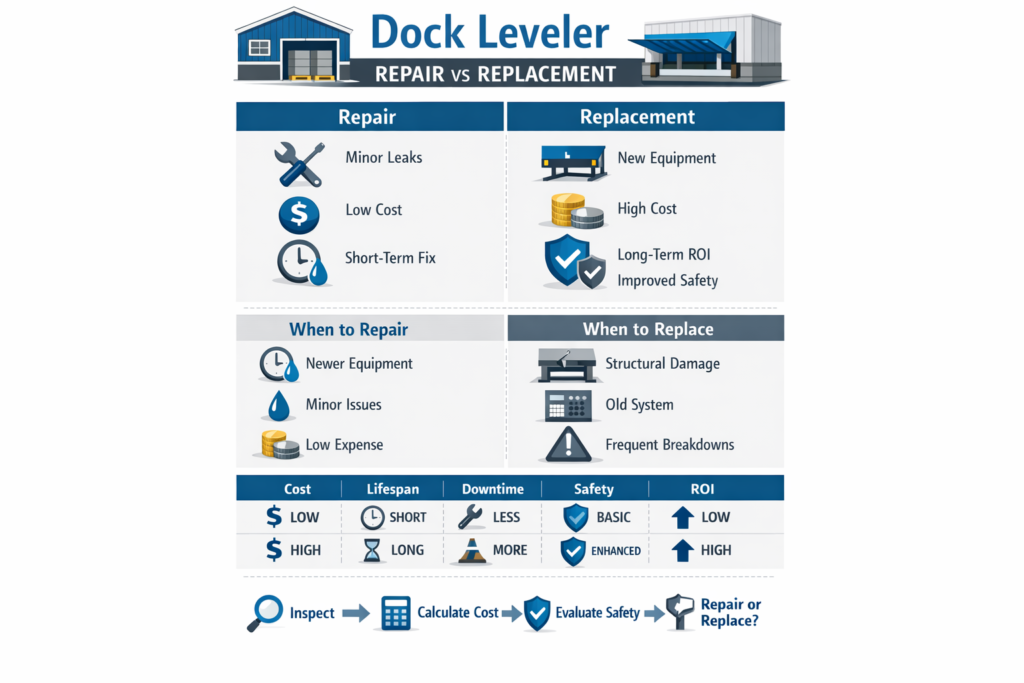
Comparison: Repair vs. Replacement at a Glance
| Feature | Dock Leveler Repair | New Leveler Installation |
| Upfront Cost | Low to Moderate | High |
| Downtime | Short (Hours/Days) | Moderate (Requires Pit Prep) |
| Lifespan Extension | 1–3 years | 10–20 years |
| Safety Features | Stays the same | Improved (Velocity fuses, barriers) |
| Warranty | Typically 90 days on parts | Multi-year manufacturer warranty |
| Long-term ROI | Decreases over time | Increases through reliability |
Step-by-Step: The Decision-Making Process
How do you actually decide? Follow this sequence to reach a data-backed conclusion.
- Review Maintenance Logs: Look at your loading dock service history for the last 24 months. If you’ve spent more than $2,000 on the same unit in two years, it’s a “lemon.”
- Conduct a Structural Load Test: Have a technician verify if the beams are still straight.
- Evaluate “Dock Shock”: Ask your forklift drivers. If they are complaining about back pain from hitting the leveler, the transition is likely too rough, indicating a need for a modern, “smooth-transition” replacement.
- Calculate Downtime Costs: Estimate how much revenue is lost when that specific bay is out of commission. Often, one week of downtime costs more than a brand-new unit.Get a Quote for Both: Ask your provider for a side-by-side quote: the cost to fix vs. the cost to replace.
Conversion Considerations: The Hidden Value of New Tech
If you choose a new loading dock leveler installation, you aren’t just getting a functioning ramp. Modern systems offer:
- Energy Savings: Better seals around the leveler prevent “air conditioning the neighborhood,” saving thousands in climate-control costs.
- Total Integration: New levelers can be interlocked with overhead doors and truck restraints so the door won’t open unless the truck is locked in place.
- Reduced Liability: Newer models include velocity fuses that stop a leveler from falling if a truck pulls away prematurely.
Conclusion & Next Steps
Choosing between repair and replacement isn’t just a financial decision; it’s a safety decision. A repaired leveler might get you through the week, but a new installation could protect your warehouse for the next two decades.
What should you do now?
- Immediate Action: Clear any debris from your dock pits and check for hydraulic fluid leaks.
- Schedule an Audit: Contact a professional loading dock service provider to perform a “Condition Report” on all bays.
- Plan Your Budget: If your levelers are over 15 years old, start a “Capital Expenditure” (CapEx) plan to replace one or two units per year to avoid a massive, all-at-once failure.
Need a Professional Opinion? Don’t guess on safety. Contact a certified loading dock repair services expert today to evaluate your equipment and keep your facility moving safely.
FAQ
A: In 2026, a standard hydraulic leveler installation typically ranges from $6,000 to $12,000, depending on capacity and pit modifications. Mechanical units are cheaper but have higher long-term maintenance costs.
A: With proper loading dock leveler service, a high-quality hydraulic unit can last 15 to 20 years. Mechanical units usually last 10 to 12 years due to the higher wear and tear on springs and pull chains.
A: Yes! This is a common service. Many companies choose to “retrofit” their existing pits with hydraulic conversion kits, which provides the reliability of hydraulics without the full cost of a new deck.
A: Lack of lubrication and debris buildup. Regular cleaning of the pit and greasing of the hinges can prevent 70% of common repair calls.