The loading dock is the backbone of any distribution center. When a dock leveler fails, it creates a domino effect of delayed shipments, frustrated drivers, and safety risks for forklift operators. While these heavy-duty steel platforms are designed to take a beating, they aren’t invincible.
If you are currently searching for “dock leveler repair near me,” you are likely dealing with one of several common mechanical or hydraulic failures. Understanding these issues—and knowing which ones you can troubleshoot versus which require professional loading dock repair services dock and door service—is key to keeping your facility running at peak efficiency.
1. The Leveler Won’t Raise or Lower
This is the most frequent call received by dock door repair companies. If the platform refuses to budge, the cause depends on the power source.
- For Mechanical Levelers: The main spring has likely snapped or lost tension. Over time, the metal fatigues, and the “pop” you hear isn’t just noise—it’s the spring failing.
- For Hydraulic Levelers: Check the power supply first. A tripped circuit breaker or a blown fuse in the control box is a common culprit. If the motor hums but nothing moves, you may have a failed solenoid valve or low hydraulic fluid.
2. The Lip Fails to Extend
The lip is the most vulnerable part of the leveler because it bears the brunt of the impact when a truck backs in. If the lip won’t swing out, it’s usually due to a bent hinge or a buildup of debris.
- Fix: Inspect the “lip keepers” for obstructions. If the hinge is bent, it usually requires professional heat-straightening or replacement by a commercial dock and door service.
3. “Dishing” of the Deck Plate
Does your leveler look like a shallow bowl? This is called “dishing.” It happens when the leveler is consistently overloaded or hit with high-speed forklift traffic.
- The Risk: Dishing creates a major trip hazard and causes “dock shock” for drivers. Unfortunately, a dished deck cannot be “unbent”—it usually signals the need for a full replacement.
4. Trailer Creep and Gap Issues
When a forklift enters a trailer, the force can push the truck forward. If your leveler keeps falling off the back of the truck, you have a “trailer creep” problem.
- Fix: Ensure your vehicle restraints are functioning. This is a critical part of dock leveler maintenance. If the restraint isn’t locking, the leveler can’t do its job safely.
5. Slow or Sluggish Operation
If your hydraulic leveler is moving in slow motion, it’s often a temperature or fluid issue. In cold weather, hydraulic oil thickens.
- Fix: Ensure you are using the correct seasonal grade of hydraulic fluid. Also, check for “foaming” in the oil, which indicates air is leaking into the system.
6. Excessive Noise and Grinding
A loud screeching or grinding sound usually means metal-on-metal contact due to a lack of lubrication.
- Fix: Apply heavy-duty grease to the hinge pins and rollers. Regular lubrication is the simplest way to avoid an expensive dock leveler repair near me service call.
7. The Leveler Won’t Stay Down
If a mechanical leveler keeps “popping up” after the truck leaves or even while being used, the hold-down mechanism is worn out.
- Fix: The hold-down teeth or brake pads may be stripped. This is a safety-critical repair that requires specialized parts from a dock and door service.
8. Electrical Control Failures
Modern docks use complex “interlock” systems. If your dock door won’t open, the leveler might be sending a false signal that it isn’t “parked.”
- Fix: Check the limit switches and photo-eyes for dust or misalignment. A simple wipe-down often fixes “ghost” electrical issues.
9. Rusted or Corroded Pits
Standing water in the dock pit eats away at the structural steel legs of the leveler.
- Fix: Ensure your dock seals are intact to prevent rain from entering. If the pit is already rusted, structural welding may be required to prevent a collapse.
10. Broken Weather Seals
Worn-out brush or rubber seals allow heat and AC to escape, but they also let in pests and debris that jam the leveler’s moving parts.
- Fix: Replace perimeter seals annually as part of your standard warehouse dock maintenance.
Troubleshooting Checklist: Manual vs. Hydraulic
| Issue | Mechanical (Pull-Chain) | Hydraulic (Push-Button) |
| Won’t Start | Broken Main Spring | Blown Fuse / Tripped Breaker |
| Stuck Lip | Debris in Hinge | Faulty Solenoid |
| Jerky Movement | Worn Hold-down | Air in Hydraulic Lines |
| Lowering Issues | Ratchet/Chain Jam | Emergency Velocity Fuse Tripped |
| Maintenance Need | High (Monthly Lubing) | Low (Quarterly Fluid Check) |
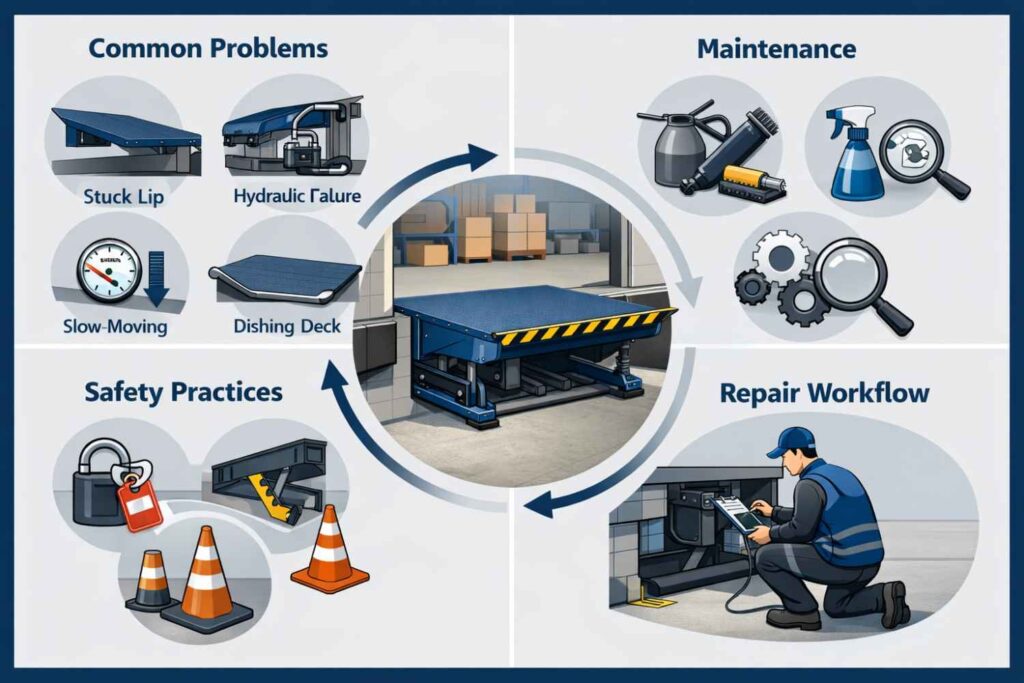
Step-by-Step: The Safe Way to Inspect a Leveler
Before you attempt any “DIY” fixes, you must follow strict industrial safety protocols.
- Clear the Area: Ensure no trucks are at the dock and no forklifts are nearby.
- Raise the Deck: Lift the leveler to its full height.
- Engage the Safety Strut: NEVER enter the pit without the steel maintenance stand in place.
- Lockout/Tagout (LOTO): For hydraulic units, turn off the power at the main disconnect and apply your lock and tag.
- Visual Audit: Look for loose bolts, cracked welds, or leaking oil.
- Clean: Sweep out debris that could interfere with the sensors or mechanical linkages.
Conversion Considerations: When to Call the Pros
While cleaning and greasing can be done in-house, most dock leveler maintenance involving high-tension springs or high-pressure hydraulics should be handled by dock warehouse dock door repair companies.
Call a professional if:
- You see any cracks in the structural steel beams.
- The leveler is “drifting” down on its own.
- You hear a loud “snap” (indicating a broken spring).
- The control box smells of burnt electronics.
Investing in a commercial dock and door service contract once or twice a year is significantly cheaper than the emergency fees charged when a leveler fails during your busiest shipping window.
Conclusion & Next Steps
A well-maintained dock is the difference between a profitable day and a workplace accident. By identifying these 10 common dock leveler issues early, you can save your facility thousands in emergency repair costs.
Your Action Plan:
- Audit Today: Walk your dock and listen for the grinding or banging noises mentioned above.
- Clean the Pits: Schedule a “pit sweep” this Friday to remove debris.
- Check the Seals: Look for daylight around your levelers; if you see it, you’re losing money on energy.
- Book an Inspection: If you haven’t had a professional look at your equipment in the last 12 months, contact us, a commercial dock and door service provider for a safety health check.
Final Tip: Don’t wait for a “Red Tag” from an inspector. Stay ahead of the wear and tear to keep your warehouse moving safely.
FAQ
A: This is often “dock shock” caused by an uneven transition between the warehouse floor and the trailer. It can also be caused by a failing velocity fuse in a hydraulic system that is triggering prematurely.
A: Basic repairs like spring adjustments or sensor alignments usually cost between $250 and $600. Major structural repairs or motor replacements can range from $1,200 to $3,500.
A: It is highly discouraged. Dock leveler springs are under immense tension. If they are released improperly, they can cause severe injury or death. This specific task should always be handled by a certified dock and door service technician.
A: With proper maintenance, a hydraulic leveler can last 15-20 years, while a mechanical leveler typically lasts 10-15 years due to more moving parts and manual wear.